

Rural Transport Group to champion connectivity and investment across England’s countryside and coast
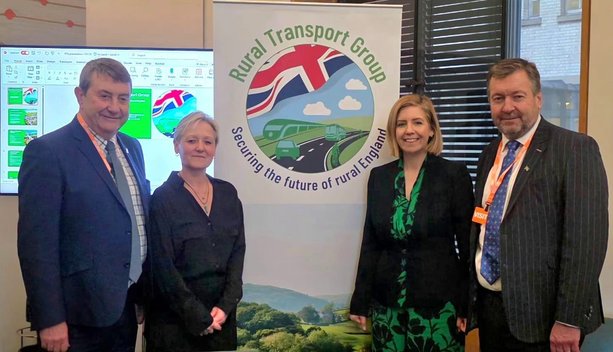
From left: North Lincolnshire Council deputy leader Councillor Neil Poole, Deputy Mayor of Greater Lincolnshire, Cllr Ingrid Sheard, Chair of the Rural Transport Group and Mayor of Greater Lincolnshire, Dame Andrea Jenkyns and leader of Lincolnshire County Council, Cllr Sean Matthews.
A NEW national partnership, the Rural Transport Group (RTG), has been launched to tackle the unique transport challenges facing England’s rural and coastal communities and unlock their contribution to the nation’s economy, environment and social wellbeing.
Chaired by the Mayor of Greater Lincolnshire, Dame Andrea Jenkyns who heads Greater Lincolnshire Combined County Authority, the RTG has brought together local authorities and expert partners to share evidence, advocate for fair funding and support practical solutions that improve accessibility and connectivity.
The launch, in Parliament, began with a discussion focused on the real challenges facing rural and coastal communities: Declining bus services, long and costly journeys to work or healthcare, road safety concerns, digital connectivity gaps and the pressures created by seasonal tourism.
The ‘roundtable’ meeting brought together representatives from across the country, including Cambridgeshire and Peterborough Combined County Authority, Transport East, the Department for Transport, Yorkshire and North Yorkshire Combined County Authority, Midlands Connect, and MPs — including Richard Tice, MP for Boston and Skegness.
The RTG will meet again to build on the work started at the launch and develop practical, evidence‑based recommendations that support better connectivity, stronger local economies and fairer investment for rural areas.
Dame Andrea said: "It is time to change the urban vantage point to one of the rural community. For far too long, our villages and coastal towns have been viewed as the periphery, when in fact, they are the very backbone of our nation’s resilience.
“Transport is the lifeblood of our countryside. It is what moves our food to market and our people to opportunity. The Rural Transport Group will turn evidence into funded action. We are not merely asking for a seat at the table; we are redefining how that table is built.
“When our rural communities thrive, the whole of Great Britain prospers."
The RTG’s first evidence summary highlights persistent transport gaps presenting challenges that increase isolation and reduce opportunity - particularly for lower income, older and disabled residents - while negatively affecting the movement of goods, workers and visitors vital to national supply chains.
At the same time, the RTG’s work has already showcased proven interventions: Digital demand responsive transport, rural mobility hubs, integrated community delivery, ridesharing, mobile service provision, improved active travel networks and accelerated digital infrastructure.
Case studies from across England demonstrate how targeted investment and partnership can deliver better, more reliable and greener connections - linking residents to jobs, education and healthcare, supporting agrifood logistics and sustaining rural culture and tourism.
The RTG will publish practical recommendations to inform national and local policy, prioritising investment where it delivers the greatest economic, social and environmental returns. By aligning transport with energy, housing, skills and digital strategies, the Group aims to build a resilient and inclusive rural transport system that works for everyone.
Rural England is home to 9.5 million people – more than 16% of the population – living in places that underpin national prosperity. Rural areas generate £259bn Gross Added Value (12% of England’s economy), host critical infrastructure, supply most of the country’s freshwater and lead on food and energy production.
They also provide significant public value through protected landscapes, heritage, tourism and nature. Far from being peripheral, rural communities are central to the nation’s resilience and future growth.