

Milestone moment for Grimsby Fish Market as it turns 30 ahead of Good Friday feast
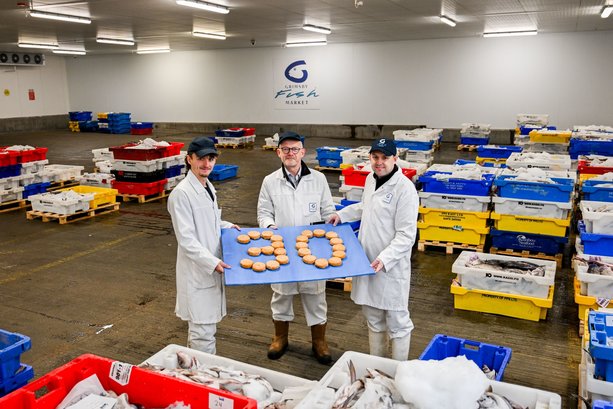
FISH CAKE CELEBRATION: Fish cakes made with haddock sourced from the auction are used to signal 30 years of Grimsby Fish Market. Pictured are, from left, Will Gibbs, trainee fish auctioneer; Nelson Hunter, fish market sales director and Danny Payne, operations director.
WHEN launched, Grimsby Fish Market didn’t just bring some of the dock’s disparate auctions under the same roof for the first time, but under an actual roof in some cases. And from a single vast shed with vital quayside and kerbside access, it has evolved into a sophisticated operation with temperature-controlled zones and chiller rooms, grading and other vital logistical elements.
It carries the latest certifications as demanded by food retailers, and also acts as a strategic trans-shipment facility for international seafood purchases between other companies.
Focused purely on commercial trade, between 40 and 60 merchants still regularly gather for the daily 7am shout auction.
Danny Payne is operations director at GFDE. He first went on the market 18 years ago to join his father as one of scores of lumpers - a job maintained today by a team of 12 to15.
He said: “Grimsby Fish Market has had to move with the times. We could see it wasn’t going to have the longevity or sustainability to keep it open as it was first built. Grimsby isn’t a fishing town as it was, but it remains a hugely important processing hub. There has been a massive change in this period, and we’ve adapted. It is no longer ‘just’ a fish market, it is a service provider to the wider industry.
“Not only do we auction the fish, we grade it, we store it, we sell it direct and we distribute it.”
The market is now a recognised hub for Norwegian and Danish market imports, providing storage and logistics between supplier and end user.
Much of this diversification was made possible thanks to a £1.5 million investment in 2012. It brought the market into the modern food safety environment.
A handful of seafood companies are now based on the premises, while businesses engaged in offshore wind also occupy offices, with additional modular buildings supporting demand that has escalated over the past two decades. “We changed what we do, and we have made it work,” Mr Payne added.
While the number of fish boxes handled is down from almost 20,000 to 5,000, the figures are still considerable. Last year 187,000 of the 50kg boxes were handled, with 150,000 selling on the auction - 90 per cent of which was Icelandic caught, arriving in the UK via container vessel.
Grimsby Fish Market’s sales director, Nelson Hunter, has sold fish throughout the 30 years, and clearly remembers moving from the West Wall and South markets to the site that united it all. He estimates he has auctioned somewhere in the region of three million boxes of fish there now.
“It doesn’t feel like 30 years, but the industry has changed. There has been so much consolidation, and of course consumer habits have changed beyond recognition,” he said.
And while the modern environment opened at the back end of the 20th century may have lifted an industry out of its Victorian beginnings, not all were happy, as Mr Hunter recalled.
“There were moans about it when we first came on! The anti-slip floor meant it was harder to move the fish boxes, with lumpers used to ice-rink conditions of the old pontoon.
“Then there was the morning sun cutting through the glass windows fronting the quayside, melting the ice the fish was packed in, as auctions began. That hadn’t been thought through! We didn’t want the fish cooking before it got out the doors!”
Teething issues overcome, it has become a magnet for vote-seeking Prime Ministers and other dignitaries on special visits, including then Archbishop of Canterbury, Dr Rowan Williams. And Mr Hunter knows why. “It still amazes me how many people are involved in providing a fish supper, and we’re proud to play our part in putting it on the table, feeding the nation,” he said.
“We’re trying to be competitive and relevant; we listen to our customers and provide a great service. Grimsby will always be a massive hub for the fish industry. We have still got such a wealth of expertise and the infrastructure, be it processing, cold storage, logistics or the port itself.”