
Beyond the Classroom: Why Maths, English and Digital Skills Matter to Hull's Future Workforce
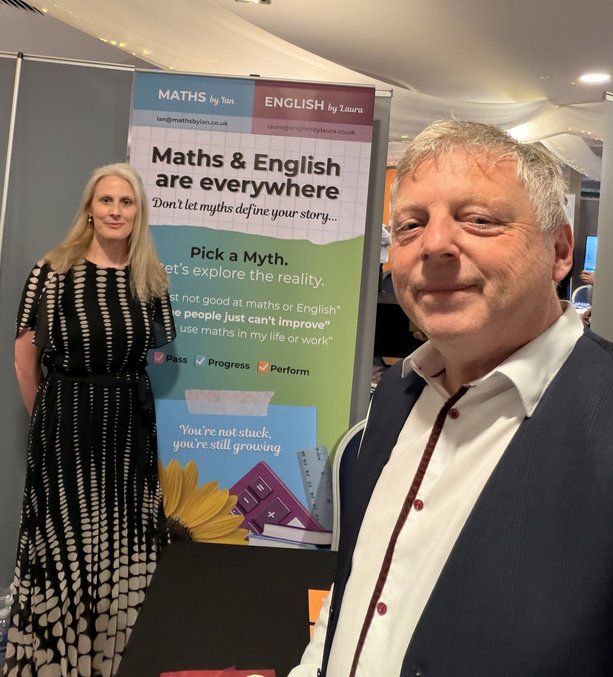
Laura from English by Laura (left) and Ian from Maths by Ian (right) showcase their educational services, helping learners build confidence, develop essential skills and overcome common misconceptions about Maths and English.
A student finishes a Maths lesson. Another finishes English. A third switches off a computer after an IT lesson. They leave the classroom and move on to the rest of their day.
But what happens if we stop thinking of Maths, English and digital skills as subjects confined to classrooms and taught in isolation, and start seeing them as skills that belong everywhere and together?
Skills that don't stop at the classroom door
Maths, English and digital skills remain useful long after the school day ends. They underpin a wide range of everyday life and workplace skills, from getting a job and managing money to solving problems, communicating with colleagues and interpreting data.
More importantly, digital skills increasingly sit alongside Maths and English. Businesses do not simply need young people who can use technology; they need people who can use digital tools to communicate, calculate, analyse, solve problems and make decisions. These are not three isolated areas of the curriculum. They are interconnected skills that people use together throughout their lives.
Making the connection visible
This is the thinking behind the developing collaboration between Maths by Ian and English by Laura, two local businesses beginning to work together on content, ideas and social media. The aim is to explore how different skills connect, rather than treating subjects as completely separate. We both work with young people across different subject areas, yet we share the same question: what happens when students understand not only how to do something, but why it matters?
Our starting point is simple:
Maths + English + Context
Maths helps you solve the problem.
English helps you understand, communicate and explain it.
Vocational context gives the problem a reason to exist.
Digital skills increasingly provide the tools through which all three can be applied.
From the pay slip to the workplace
Imagine a young person receiving their first payslip. They need Maths to understand gross pay, deductions, tax, National Insurance, overtime and monthly income. The numbers alone, however, are not enough. They also need English to understand the terminology, interpret information, read contracts, ask questions and communicate with their employer. Increasingly, they may need digital skills to access a digital payslip, navigate an online payroll system or manage their finances.
This is a simple example of something we use every day: the skills do not work independently.
The same is true in the workplace.
Consider Hull's port and logistics sector. A young person working in this environment might need to calculate weights, distances, timings and costs, but that is only one part of the job. They may need to interpret information, follow instructions, identify a problem and decide what to do next. They could then use a spreadsheet or another digital system to record information, analyse data or update a schedule before communicating the outcome clearly to a colleague or customer.
Maths, English and digital skills are not three separate tasks here. They are being used together to get the job done.
Skills for Hull's future workforce
This matters because Hull and East Yorkshire has a diverse and evolving economy. Current growth priorities include ports and logistics, manufacturing, energy, agri-food and agri-tech, as well as construction, digital, professional services, health and social care.
For education, therefore, the question is not simply whether young people can pass their Maths and English qualifications. It is whether they understand how those skills can help them navigate the opportunities available to them.
For anyone entering or progressing in the workplace, employers need people who can calculate, read, write, communicate, solve problems, reason and learn. These abilities are sometimes called soft skills, but there is nothing particularly soft about them. They provide the foundation for building careers, adapting to change and learning new skills throughout working life. The challenge is making these connections visible to young people while they are still at school.
From qualifications to pathways
This is where the conversation between schools and employers becomes important. Employer-led HEY LSIP 2.0 focuses on connecting employers, educators and learners, while ensuring that skills provision responds to local workforce needs. That connection needs to begin before a young person walks through the door of an apprenticeship or their first job.
When students can see where their learning might take them, local opportunities and apprenticeships become more than something they hear about at the end of Year 11. They become part of a pathway.
And that pathway matters for Hull.
If we want talented young people to build their futures in Hull, we need them to see the careers, employers and opportunities available in Hull. We also need to recognise that learning does not end when someone leaves school. Careers change, industries evolve and technology advances. The ability to learn, communicate, calculate, reason and adapt remains relevant throughout a person's working life.
Learning for life
Maths, English and digital skills are not qualifications we acquire and leave behind. They are capabilities we continue to develop throughout our working lives. Whether someone is starting their first job, progressing in a career, changing direction, retraining or helping a business adapt to new technology, these skills remain relevant.
This is also reflected in the Combined Authority's current skills strategy, which emphasises training and lifelong learning for all ages, while supporting education and training that responds to current and future employment needs. The ambition, therefore, is bigger than improving classroom outcomes. It is about helping people develop the confidence and skills to open doors in education, employment, business and everyday life.
What's next
The next stage is to take the conversation beyond the classroom and into the workplace. We want to work with a small number of local businesses to showcase the skills people really use at work — but, crucially, to hear those stories from the young people doing the jobs.
With just a little time from each business, we could create a series of real examples showing how Maths, English and digital skills come together in different workplaces, the routes young people have taken and what they have discovered along the way.
The businesses get an opportunity to open their doors. Young people get to see what lies behind them.
And perhaps the question is: what would happen if more young people could hear about careers from the people actually doing them?
Opening the door
We cannot lock Maths, English and digital skills in a classroom, teach them in isolation and expect young people to understand their value. They belong in the workshop, the office, the hospital, the building site, the warehouse, the shop, the kitchen, the port and the home. They belong in conversations about money, careers, business and the future.
And they belong in Hull.
If we want young people to see a future here, we need to help them see the connection between what they are learning today and the opportunities that exist around them tomorrow.
Perhaps the question is not whether young people need Maths, English and digital skills. Perhaps it is whether we are doing enough to show them why.
For further information please contact ian@mathsbyian.co.uk